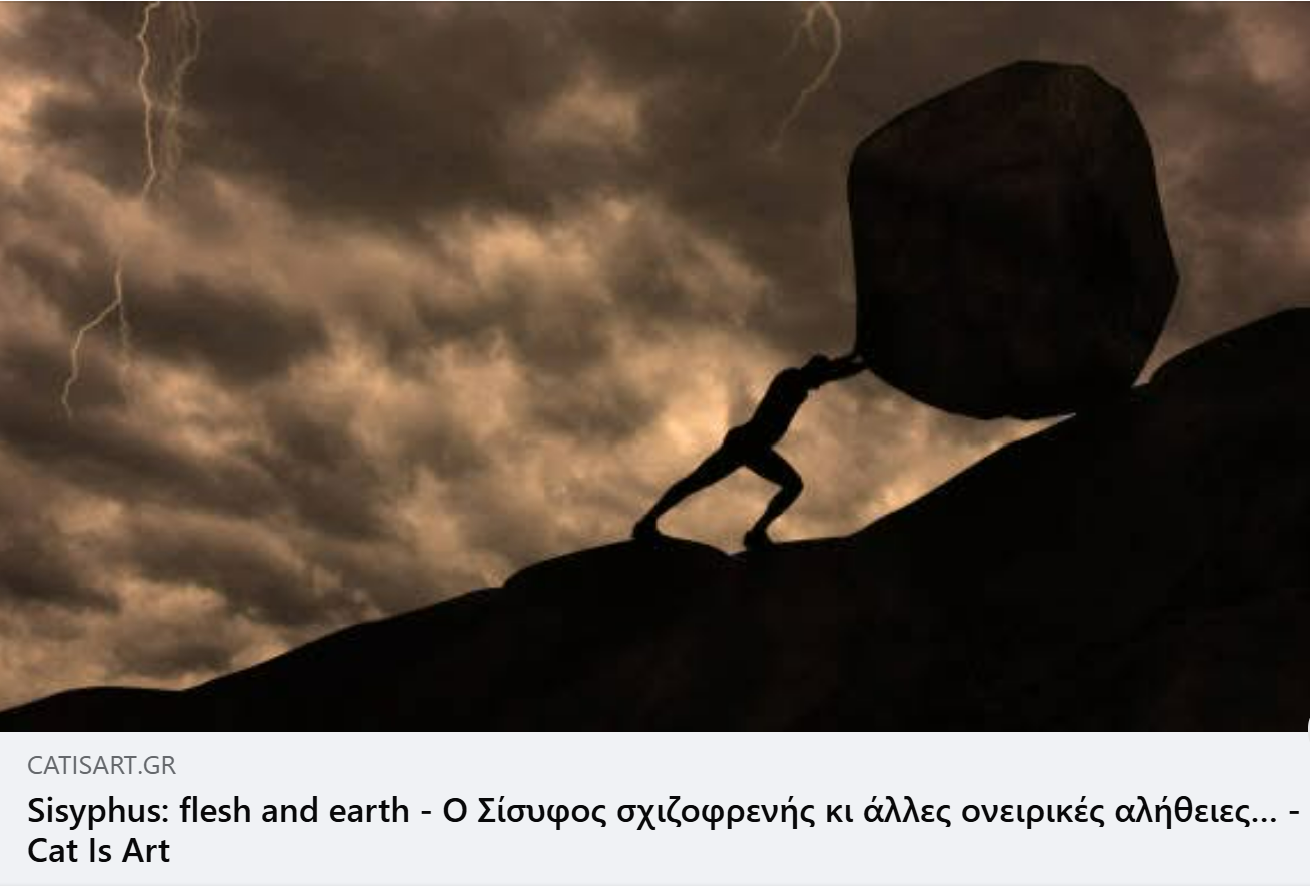
By Kostis
Megalis
Is Sisyphus
schizophrenic? Here's an interesting idea. Why, if you were carrying a rock up
and down for eternity, wouldn't your mind soon lose its way? Wouldn't it start
confusing fantasy with reality, dream with waking life?
But, the
correct formulation is not Sisyphus schizophrenic. Because the character from Sisyphus:
flesh and earth does not present himself as Sisyphus. But, as the shadow of
Sisyphus. One could say an incarnation of the Sisyphus archetype. A morphing of
the universal. The manifestation of a myth in a person's life. Someone who
could be me or you, and certainly at some point is me or you...
I say all
this because this very special performance helped me redefine my own
relationship with the myth, to feel again, as if for the first time, the story
of Sisyphus in a new way. The rock ceases to be only the Absurdity of human
existence, the absurdity of a life that has no meaning in itself, although that
is all we want - a life that, precisely because it has no meaning in itself,
only we can invent it from the invalid materials at our disposal (but this is
very difficult and takes a lot of time). The rock also becomes time. Man drags
his stone, tries to command time, but the rock always falls, the sickle of
Saturn always beheads us, since Today runs, runs away and we lose it all for a
past that will never come again and a future that has not even come yet. The
protagonist, the shadow of Sisyphus, fears that all this is just a dream, but
ultimately, he is even more lost in a dream, which is in another dream. One of
his personalities is chasing freedom from destiny. He is personified in a bird,
which tries to fly free, but returns without even leaving, since it is a
chicken.
Stone men figure carrying stone, baroque statue from Greek mythology of
Sisyphus or Sisyphos, garden, green trees background, czech republic
It has
wings, but it cannot fly. In an amazing performance, Fanis Katehos constantly
plays with his whole body, so that his words give one emotion, his face
another, his hands another, his feet another – but all are harmonious members
of an indivisible whole. The shadow of Sisyphus maniacally moves the rocks,
constantly trying to fly, but remains trapped in the same prison, perhaps
because he is dealing with the symptom instead of the cause, perhaps because he
is trying to figure out what to do with the rocks instead of just letting them
go, or simply accepting that they are inevitable and he should just enjoy the
process. Either the prison door was always open and he just didn't look for it
properly, or it never existed and so why would he look for it. In any case, the
whole search for the key is just futile and a waste of his time.
The
direction [Donald Kitt] and music [Tasos Fotiou] are excellent in reinforcing
all this futility, which accompanies the personal struggle of each of us on the
path of freedom, self-realization and happiness. A futility, which far from
discourages Sisyphus from continuing his sacred struggle. Quite the opposite.
Rather, it excites him, makes him fight even more maniacally…
Just like
the truth, every text does not end, it cannot have a real conclusion, but it
can have something like a conclusion, something that is rather something like a
key. For the end, which is not an end, then, I leave these lyrics, which this
particular performance inspired me:
We are the
clowns, who laugh at the gods and fight them even though they know they will be
defeated. And above all, this is what drives them. And they fight like dogs to
flee like Suns. But, they are already falling, rather they are falling like
Suns. They fight the gods like dogs, Like dogs they love, like dogs they try to
see life, not to be forgotten and to be forgotten and to live it: Very easy,
for a moment to look away And life has already become stardust, lost for good…
Source: www.catisart.gr
Translated by Google.